The Most Powerful Ad Is the One Your Brand Never Bought
A bottle appears on screen for seconds.
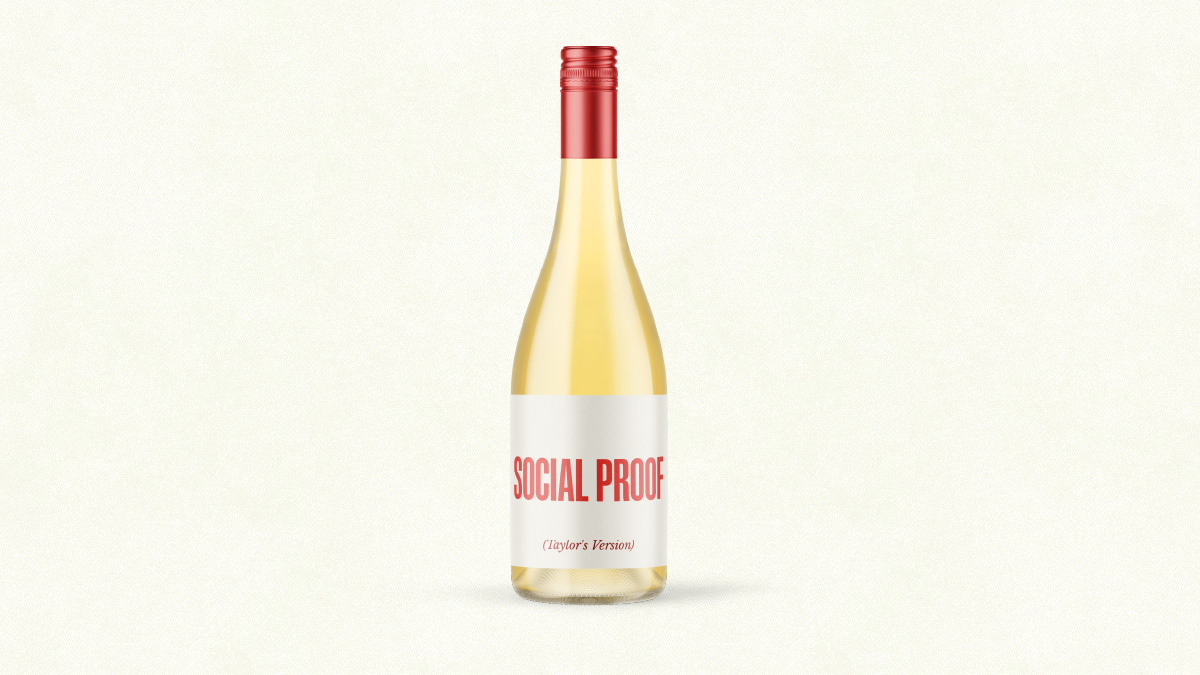
No close-up. No call-to-action. No #ad. Just a glass of Sancerre in a Taylor Swift Disney+ documentary.
And then… it sells out.
That’s the story from the Loire Valley, where Domaine de Terres Blanches saw a fivefold sales jump after Swift fans identified the wine and posted where to buy it. The winery owner, Laurent Saget, didn’t even know it had happened until someone sent him a screenshot. He was closing up for Christmas.
Here’s the part leaders should sit with:
The product didn’t win because it was promoted. It won because it was chosen. And then witnessed.
That’s social proof in its purest form.
Social proof isn’t persuasion. It’s permission.
Most marketing tries to persuade.
Social proof does something more efficient: it gives people permission to want what they already suspect is desirable.
In this case, the “proof” wasn’t Taylor holding the glass. It was millions of Swifties acting like a distributed intelligence agency—spotting the label, naming the exact producer, and broadcasting buying instructions across social platforms.
So the buyer isn’t thinking: “Should I buy this wine?”
They’re thinking: “If they found it, and she drinks it, and everyone’s buying it… I’m safe to join in.”
Social proof short-circuits doubt.
The uncomfortable satisfying truth: the brand did nothing
This is what makes the story so instructive.
Because most brand teams respond to this kind of moment with a business-first reflex: “We need an influencer strategy.” “We need product placement.” “We need an endorsement deal.”
Maybe. But notice what actually happened here:
The winery didn’t plan it. The demand spike arrived instantly and externally. And the producer couldn’t even scale production to match it—region limits, climate impacts, fixed vineyard size.
So where’s the brand decision in all this?
Nowhere. And everywhere.
Saget didn’t make a brand decision that week. But his family has been making them for nine generations. The distinctive label. The quality that justifies a €30-40 price point. The restraint to age wines properly rather than rush them to market. The commitment to craft over volume.
These aren’t marketing tactics. They’re accumulated brand decisions that created something worth signalling—long before Taylor Swift picked up the glass.
The business-first reflex would have been to expand, dilute, chase trends. Saget’s response to the spike? “They want more, but we will not give them more. That’s not what we do.”
That’s a brand decision. And it’s exactly why the wine was worth talking about in the first place.
The Connect in FULL lens: proof accelerates the journey—but can’t replace it
Let’s put this through the Connect in FULL sequence.
Found. Swifties made the wine findable. Not with a media plan, but with obsessive collective attention and shareable purchase paths.
Understood. They didn’t just spot a bottle. They framed it as “Taylor’s favourite wine.” That story travels faster than tasting notes ever will.
Loved. Love is where repeat lives. This is the bit many brands miss: a sell-out is attention. Love is preference that persists. Saget himself suggested the spike may create a shortage later, not a new long-term demand curve.
Lived. If people start serving it at dinner parties as a signal (“this is that wine”), then the brand moves from a moment to a habit. That’s when it becomes cultural.
Social proof can rocket you to Found and Understood. But if the liquid, experience, and meaning don’t hold up, it doesn’t convert into Loved and Lived. It just burns bright and disappears.
Why this matters: proof is now the primary media
We’re watching a shift. Media used to be bought and broadcast. Now it’s captured and cascaded.
Swift’s wider economic impact is well documented—economists upgraded Singapore’s growth expectations around her tour. But the wine story is the cleanest micro-example because it shows the mechanism:
- A credible signal (the “who”)
- A visible artifact (the “what”)
- A motivated community (the “who else”)
- A frictionless path to purchase (the “where”)
No brand deck required.
Five ways to earn social proof (without becoming an influencer chaser)
- Make your product “sleuthable.” If someone screenshots your pack, can the internet figure out what it is? Clear distinctive assets. Legible pack codes. Recognisable silhouette. Searchable naming. If your pack is a fog, you’ve made proof harder to transmit.
- Build communities, not just reach. Swifties weren’t a passive audience. They were an engine. The modern equivalent for FMCG isn’t “find bigger influencers.” It’s find tighter tribes—people who want to do the work of sharing because it reinforces who they are.
- Create proof moments on purpose. You can’t manufacture authenticity, but you can design moments that get witnessed: rituals people want to film, tiny “someone gave a damn” details, packaging interactions that feel good to share. Business-first brands strip these out as “non-essential.” Brand-first businesses treat them as distribution.
- Be ready for the spike. If a moment hits and your product is out of stock everywhere, you don’t just lose sales. You lose momentum. Even in constrained categories, you need a plan: allocation, waitlists, retailer comms, owned-channel capture.
- Convert borrowed proof into owned memory. The trap is thinking the spike is the strategy. Use the attention to build assets that last: email capture, loyalty hooks, brand story people can repeat, distinctive cues that make next time easier to spot and choose. Rented attention fades. Owned memory compounds.
The real lesson: social proof is a brand dividend
The winery didn’t “do marketing” in that moment. It collected a dividend from something deeper: desirability, credibility, and a product worth signalling.
That’s the shift I want more leaders to make.
Stop asking: “How do we get talked about?”
Start asking: “What would make us worth talking about—without us being in the room?”
That’s brand-first thinking.
And it’s how you turn a fleeting screenshot into staying power.